Showing posts with label Philippines. Show all posts

Wednesday, September 20, 2017

Philippine Bangkas - More Design and Construction Details

In our previous post, we looked at details of outrigger design and construction in the Filipino outrigger boats known as bangkas. Here we'll look at other design and construction details in additional images from Michael Williams of Flatwolf Photography, to whom we express our thanks. (Click any image to enlarge.)


Philippine bangka boat - Flatwolf Photographer
Bangkas were originally built as dugout canoes, then as extended dugouts (i.e., with strakes added atop the dugout base to increase freeboard). As shown in this bangka undergoing repairs, plywood construction is now more common. The bottom remains a heavy plank -- perhaps a bare artifact of the original dugout concept. A roughly-hewn stem is scarfed onto the bottom, but perhaps it will be fined up before the missing side planking is replaced. Straight frames support the sides. Not visible here, but shown in the previous post (3rd image from top): there are no frames across the bottom; the side frames merely butt against the top of the bottom plank.
Philippine bangka boat - Flatwolf Photographer
Some larger bangkas have a sharply flaring top strake. This would widen the top of the hull for more interior room, deflect spray, and increase buoyancy if the bow plunges in rough seas.
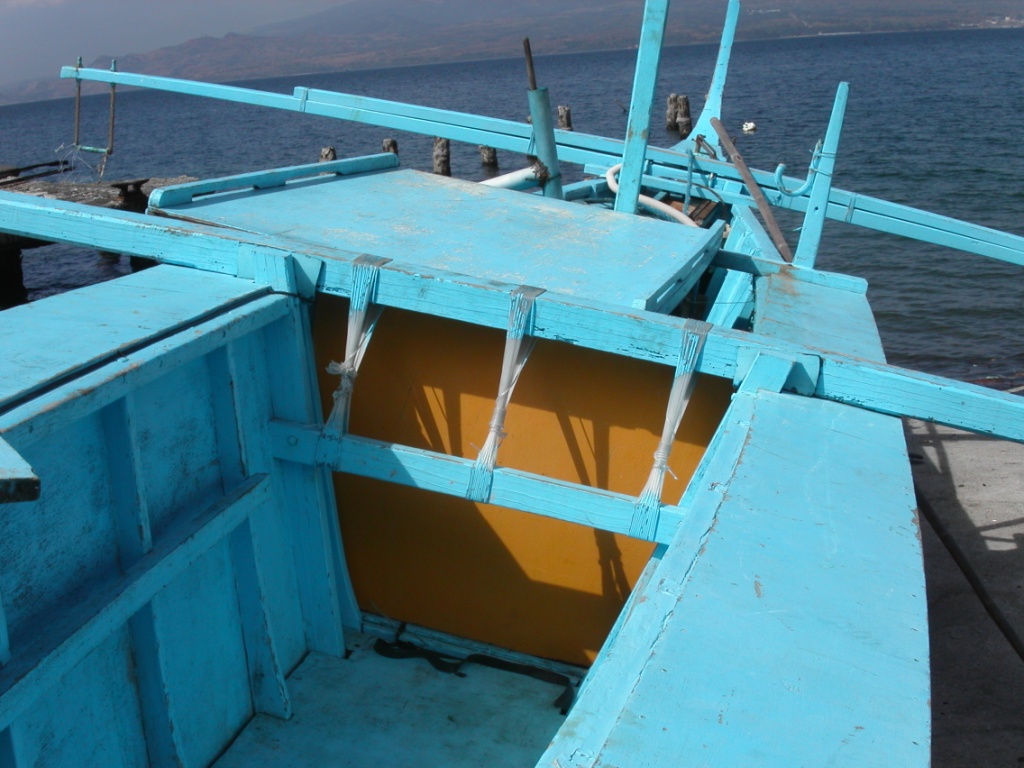
The outrigger booms show both similarities and differences from that on another large commercial passenger bangka shown in the previous post (6th from top). The forward boom consists of an open-top box beam making up about half of the boom's total length. Inside the box are five bamboo poles, two above three, all of which extend beyond the box. The bottom three poles extend farther than the top two and connect directly to the outrigger float. The next boom back lacks the box beam, and has the poles supported across their middle lengths by what might be a flat plank or possibly additional shorter poles.
It's unclear if the nicely shaped outrigger float is a solid carved timber or -- what we think more likely -- a hollow plywood or composite construction.
Philippine bangka boat - Flatwolf Photographer
The flaring top strakes on this this bangka dive boat extend into a long, overhanging bow that supports a flat platform.
Philippine bangka boat - Flatwolf Photographer
A bangka of similar size to the one above lacks the flaring top strake, and its long, extended bow is narrow and not intended for use as a platform.
Philippine bangka boat - Flatwolf Photographer
This small bangka has an elegantly vertical sternpost.
Philippine bangka boat - Flatwolf Photographer
In contrast, these small power bangkas have steeply sloped sternposts.
The running gear is of notably light weight and entirely exposed, requiring great care when operating in shallow water and when hauling the boat onto the beach. The rudder post is secured outboard to starboard and is turned by a short tiller connected to a push-pull rod, allowing the helmsman to sit forward of the engine box.


Friday, September 15, 2017

Philippine Bangka Outrigger and Boom Variations

The bangka -- also known as banca and paraw -- is a double-outrigger boat ubiquitous in the Philippines. According to one online dictionary of Tagalog (an Austronesian language, one of the more commonly spoken languages of the Philippines), the word bangka simply means "boat," and this appears to be accurate and logical, given the great diversity in bangka configurations.

Indeed, there seem to be only two or three common features of bangkas: their main hulls are always narrow; they are always double-ended; and they almost always have two outriggers. Their differences, however, are manifold, including variations in materials, construction methods, most aspects of hull shape, houses, internal arrangements, overall size, propulsion, decoration, and usage. They're sometimes called the "Jeeps of the sea" because they are supposed to be able to do everything, but they do everything not necessarily because they are versatile, per se, but because there's a different style of bangka for nearly every possible application. 

We've written about bangkas several times already, but an offer of photos from reader Michael Williams of Flatwolf Photography has given us a good reason to look at them yet again. What strikes us most about the current batch of images is the variation in the configuration of outrigger booms. As always, click any image to enlarge.


Philippine bangka boat - photo by Michael Williams
We'll begin with this image of a medium-size power bangka as a kind of baseline for comparison. The outrigger float -- a single bamboo pole of large diameter -- angles fairly steeply up toward the bow. To achieve this, forward boom slopes down quite gently, while the aft boom takes an abrupt turn downward. One finds these two boom configurations in different combinations on different bangkas.
Philippine bangka boat - photo by Michael Williams
Three booms with progressively steep ends to accommodate the sloping floats. The booms are stout and rectangular in section. Round poles lashed atop them do not seem to add much, if any, strength.


Philippine bangka boat - photo by Michael Williams
The boom in this small paddling bangka is fastened with lashings to a cleat that spans between two frames about halfway between the gunwales and the bottom of the interior. The frames themselves extend above the gunwales, providing stops that prevent the boom-and-float assembly from shifting forward or aft.
Philippine bangka boat - photo by Michael Williams
The booms to the right and left of the image are straight across the middle, while the boom in the middle is bent down somewhat amidship, for a bit of a gull-wing configuration. The booms appear to be built up of three sections, the joints visible where the horizontal section transitions to a downward curve toward the float. The joints are probably simple scarf joints, lashed with cordage and covered with some kind of sealant or adhesive. 
Philippine bangka boat - photo by Michael Williams
These light, obviously very flexible booms in this nicely finished, small power bangka appear to be in one piece, although they might be scarfed together as in the previous photo but finished more carefully. The booms are placed outboard of the extended frame tops. In comparison, the booms on the boat in the third photo were placed inboard the extended frame tops.
Philippine bangka boat - photo by Michael Williams
The five booms on this large passenger bangka are complex structures. Amidships, each appears to be an open-topped, box-section girder from which a tapered, rectangular-section beam protrudes outboard with a slight downward slope. Lashed on top of these are several bamboo poles, lashed together and extending further outboard. One pole in this bundle extends even further outboard and curves downward to contact the float, which is itself a few bamboo poles of small diameter, providing probably only modest buoyancy. In the main, the booms appear to be quite rigid, although the lightness of the final outboard section may impart some flexibility.
Philippine bangka boat - photo by Michael Williams
A single-outrigger bangka. This appears to be by design, and not a partially disassembled boat. The float is a carved piece of timber, not a bamboo pole as in most other examples. The amount of flexibility in the construction appears to be minimal.
Philippine bangka boat - photo by Michael Williams
The outriggers on this small paddling bangka tilt downward toward the bow. We can't think of a good reason for this unusual design feature.

Wednesday, January 15, 2014

From Pacific Islands: Peabody Museum #7

Let's look at some more maritime-related objects from several Pacific cultures on display at Harvard University's Peabody Museum of Archaeology and Ethnology. (Earlier posts in this series on the Peabody looked at Baffinland Inuit, Aleut, other Alaskan Eskimo, and Chinook, Coast Salish, et al, other Pacific Northwest exhibits, and a large stitch-planked monohull canoe from the Solomon Islands.)


Maori canoe model
This canoe model from New Zealand was collected prior to 1850. Its origin is probably Maori. The base of the hull appears to be carved from a single log, as would have been the real canoe that it represented. It measures approx. 108" LOA. (Click any image to enlarge.)
Moari canoe model stern decoration
Elaborately carved stern decoration on the Maori canoe model. 
bow decoration on Maori canoe model
Bow decoration on the same model. The carved washstrakes are stitched to the dugout hull, and a black half-round batten is captured by the stitches. On a real canoe, some kind of vegetable fiber and mastic would have been placed beneath the batten to make the seam watertight.
The museum has an impressive display of adzes from various Pacific cultures, most with stone blades. The adze is the primary tool for dugout canoe construction.
stone adze collection
This side-hafted adze from the Carolina Islands has a blade of sea-turtle bone and bindings of twisted coconut fiber.
New Guinea stone adze
This adze from Kirapuno, New Guinea, has a reversible stone blade held in place with nicely woven rattan binding.
Navigational stick chart from Marshall Islands
Navigation chart from the Marshall Islands, made of the midribs of palm leaves, shells, and hibiscus and banana fibers.
Phillipine double outrigger canoe model
Collected prior to 1903, this model Philippine double-outrigger sailing canoe has a squaresail rig, a dugout base and trifurcated ends, with two of the horns at each end turned up sharply. The outrigger floats are attached directly to the straight outrigger booms, placing the floats quite high -- possibly above the load waterline.
Hawaiian double canoe model
The struts on this Hawaiian double canoe model (wa'a kaulua) curve up between the hulls before passing through the washstrakes just above the gunwales of the dugout bases. Naturally-grown, curved timbers were used on real canoes. The curvature raises the struts above some splashing waves.
Hawaiian single outrigger canoe model
The unadorned simplicity of this single-outrigger Hawaiian paddling canoe model clearly identifies it as a workboat for inshore fishing and/or transportation.  
Indonesian canoe model
Whereas the two previous canoe models from Hawaii were representational, this delicately carved canoe-shaped effigy vessel from Indonesia probably had a ceremonial purpose. 
Sandwich Islands bone fishhook
Composite fishhook of bone, fiber and wood. The display card says it's from the "Sandwich Islands": one wonders why the museum chose to use this antiquated name for Hawaii. A leader is bound to the shank of the hook, the bindings tightened by an inserted wooden wedge.

Friday, June 21, 2013

The Practicality of the Philippine Banca


Beautiful curves on the sheer and outrigger booms on this Philippine banca. The booms are carefully chosen for their curves from the branches of a native thorn tree. Each side of each boom is a single branch, lashed together where they overlap amidships. (Copied from the Facebook page of Tropical Boats, a cultural tourism company.)
A new comment by Robert La Quey on an old post about Philippine bancas seemed so interesting that I want to highlight it in its own post. Here's his comment:
I can assure you that bangcas are alive and well. If you show any narrow boat to a filipino fisherman he will immediately suggest that you add outriggers and bamboo amas. First and foremost most bangcas are rafts for working t sea and so stability is king. But fast access from the shore to the workplace off shore is essential as well. So the narrow hulls, easily driven by very inexpensive single cylinder pump motors. I have tried and tried but it is damn difficult to design a boat that is a better match to the requirements of the typical Filipino than the bangca.
Flat bottom bangcas built of plywood are emerging. Planing boats, very fast on and off shore. Many variations but all have the classical bangca outrigger setup with bamboo amas.

Photos of our bangcas here https://www.facebook.com/photo.php?fbid=585396104825590&set=a.350169285014941.86952.350169078348295&type=3&src=https%3A%2F%2Ffbcdn-sphotos-c-a.akamaihd.net%2Fhphotos-ak-frc3%2F977338_585396104825590_659414029_o.jpg&smallsrc=https%3A%2F%2Ffbcdn-sphotos-c-a.akamaihd.net%2Fhphotos-ak-frc3%2F970528_585396104825590_659414029_n.jpg&size=2048%2C1536
 
and here
https://www.facebook.com/pages/Macho-Tsongo/388093857895410


For those of you who don't do Facebook (poor, benighted souls), here's the "About" verbiage concerning Mr. La Quey's business, Tropical Boats:
About  Tropical Boats is for adventuresome tourists. We build boats and arrange tours in our own boats and can provide a wide variety of accomodations, ranging from tents to fine resorts. Create your dream vacation. We make it a reality. 
Mission  Tropical boats uses boat building to introduce tourists to another way of life ... that of the poor but free Filipino fisherman. Our mission is to open minds and hearts to realities not often considered in the developed world. 
Description  During a typical class at Tropical Boats you will build a Filipino bangka (outrigger canoe) during the first week. During the second week you will go fishing in your bangka with a Filipino fisherman. Food and accommodations will be provided as well as weekend entertainment.
This sounds like a fantastic vacation to me. Here's Mr. La Quey's contact info:
Phone: +63 947 949 5887
Email: robert.laquey@gmail.com

Copied from Mr. La Quey's Facebook page, I have no  information about this photo, but I love the way these little Philippine folks have their own beautiful little banca.
Macho Tsongo is a 10-meter banca based in Ligtasin Beach, "available for day trips around Matabungkay Bay and Fortune Island," according to its Facebook page, which continues: "We also provide custom tours for overnight camping and fishing around Caltagan Point to Balayan Bay and to areas around Lubang Island."


Saturday, October 20, 2012

Bancas on Corregidor

Reader Paul Wilson sent me a bunch of wonderful photos of boats from various parts of Asia which we'll looking at in this and the next several posts. We'll start with Paul's photos of bancas or paraws, the double-outrigger canoes of the Philippines. (Earlier posts examined banca hull and outrigger shapes, banca propulsion and steering, and banca construction details.)

To quote Paul:
The Philippines Paraws (Bancas) photos were taken in 2002 at the island of Corregidor in Manila Bay.  I loved seeing how the outriggers were attached using heavy fishing line and pipe fittings.  Very practical.  
The garbage from Manila floats across the bay.  As you can see, it is a bit of a problem.
Apply that familiar slanting red stripe at the bow, and even a banca becomes instantly recognizable as a coast guard vessel. (Click any image to enlarge.)
Like most modern bancas, these are inboard powered. The hull appears to be of plywood construction over sawn frames. The text on the stern says "Donated by 125th Coast Guard Auxiliary." (See next image.)
The attachments between outrigger boom and float appear to be pipe hangers. Paul's comment about the garbage being "a bit of a problem" is apparently understatement. 
Yuck. A sorry setting for a handsome boat.
That's more like it! A handsome boat with a nice paint job deserves a clean backdrop.

The banca's narrow hull makes the double outriggers a necessity.
This photo and next: an abundance of heavy-duty monofilament fishing line secures the booms to the hull and the floats to the boom on this banca. The boat in the previous photo had two parallel lengths of bamboo for each float. This one has three. I've also seen floats of one and four lengths: it depends upon the diameter and buoyancy of the bamboo available and the stability needs of the boat.

Tune in again soon for more photos of indigenous Asian boats by Paul Wilson, to whom we give sincere thanks.

Thursday, January 12, 2012

Models in the Madrid Naval Museum, Part I

If you get tired of fine art at Madrid's incredible Prado museum, a nice break is the Museo Naval de Madrid, almost next door. Run by the Spanish armed forces, it has extensive exhibits of Spain's naval history, ranging from Columbus to the present-day Spanish navy. The exhibits are entirely in Spanish, so those who don't read the language have to be able to appreciate what they see without explanatory material.


In this post, we'll look at the museum's models of Philippine boats. Of course, the Philippines were a Spanish colony prior to the Spanish-American War, and the Spanish had plenty of opportunity to observe the local watercraft and collect models thereof.


The museum allows photography but not the use of flash which, combined with the fact that all the models are behind glass, partially explains the quality of the photos here. Click any image to enlarge. Captions are my inept translations of the Spanish exhibit cards. My own comments follow the main captions, in parentheses.


Philippine Prao (19th c.), Dugout for passengers and fishing. (double outrigger, Chinese-style reed-mat lugsails.)

Banca (19th C.), Philippine, passenger vessel used in ports and bays; also for fishing. (Double outrigger, canoe-shape hull, multiple thwarts, European-style lugsail with a line of reefing points. No rudder: might have been steered with a paddle.)

Casco (19th C.), Philippine river cargo launch (To all appearances, a Chinese Sampan. Chinese-style mat sails look very small, are probably not to scale. Identification might be faulty. If so, probably my error.)

Panco (19th C.), Jolo, Philippines. Used for piracy. (Top view. This ungainly vessel seems unlikely for its stated use.)

Casco (19th C.), Philippine river cargo launch (Euro-style lugsails with vertical seams)

Guilalo (18th C.), Philippine, used especially on the Bay of Manila to transport passengers into the capital and Cavité. (Settee sails have an Indian Ocean flavor. Double outrigger. Clipper bow.)

Sunday, July 10, 2011

Bancas III

I shouldn't be blogging this weekend: I should be on a week-long canoe trip on the West Branch of the Penobscot River. But a bad back forced cancellation of the trip, so instead, while I'm sitting around healing, here's the third of three posts on Philippine bancas, this one concentrating mostly on construction details. (Previous posts on bancas are here and here.) As always, click any image to magnify.
1. This deteriorating banca is clearly of "five-part" canoe construction: a dugout base upon which are attached single side strakes, and large bifurcated stempieces bow and stern to close in the raised sides.

2. This hull also appears to be built on a dugout base, but it's interesting that it is flat-bottomed. Also note the complex frame-piece that supports the raised sides and provides a mounting/lashing point for the outrigger boom. The lashings appear to be cheap synthetic material.

3. A hull under repair, with one side-piece removed, shows multiple combination frame-thwart assemblies and a stringer that appears to run along a joint between lower and upper side-strakes. Note how the frames bulge around the stringer.

4. Not a construction shot, this one shows a different hull configuration than we've seen before, with very high sides relative to length; a fairly sharp transition between the bottom and the stems; sizable decks fore and aft; and a distinct, well-protected cockpit defined by square-ended coamings all around. With its high freeboard and coamings, this style of hull is intended for use in rougher waters.

5. Massive, roughly-hewn side-strakes are tacked to the outer surfaces of a narrow dugout base. (In photo #1, in contrast, the side-strakes are flush with the upper edge of the dugout base.) The bottom ends of the outer stems are temporarily being held in place by lashings.

6. A trio of newly-built hulls of the deep, coaming-protected type shown in photo #4. The one on the right shows a stringer joining upper and lower strakes, and has a pointed front coaming made up of two pieces.
Photos courtesy of Capt. Rob Whitehurst; please do not re-use without permission.