Showing posts with label Bronze Age. Show all posts

Friday, March 10, 2017

Bronze Age Carpow Logboat Moves to Permanent Home in Perth

We haven't had time for a post lately, so to keep the pump primed, we'll bring this recent news item to your attention, courtesy of The Courier.

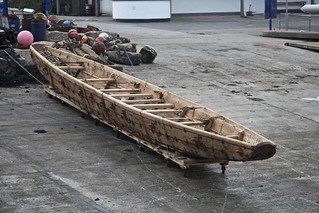
The Carpow boat, a 3,000-year-old logboat excavated in 2006 from the River Tay in Scotland, was recently moved to a permanent home at the Perth Museum and Art Gallery. The 9.25-meter-long boat was recovered in generally very good condition, and it includes the transom board that closed in the stern. It is the second oldest logboat discovered in Scotland. Sadly, much of the bow is missing, but it is still one of the best-preserved Bronze Age logboats in Britain. This short video summarizes the excavation.


This next video shows the boat after conservation. The transom board is not in place, but you can clearly see the bosses that held it there, which were left standing on the inner surface of the boat when the trunk was carved out.


Wednesday, June 25, 2014

Irish Logboat Finds

An article in the current issue of Current Archaeology tells of multiple logboat finds in Lough Corrib, County Galway, Ireland. I haven't seen the full writeup (it's pay-to-read), but a decent summary appears here.

The five boats, found in various locations around the large lake, were discovered during a bathymetric survey, and they were preserved by the lake's soft mud bottom and (presumably) cold temperatures and still waters at depth. One of the logboats, dated to about 4,500 BCE (Early Bronze Age), exhibits 2-3cm raised features carved on the inner side of the hull. There is a lengthwise feature that serves as a kind of keelson, and four cross-members. The article speculates that these served to divide the hull into compartments, but I think it more likely that they served as strengthening members in the nature of ribs.
Bronze Age Irish logboat (Source Current Archaeology)
The Early Bronze Age logboat found in Lough Corrib is 12 meters long and probably had a crew of 10-12 paddlers. (Source: Current Archaeology)
A 3,400-year-old boat was apparently carved in two halves, held together by rods that passed through internal cleats on the interior of both halves, and probably supplemented by lashings through bored holes. (The article summary is ambiguous on this point.) This strongly suggests kinship with the sewn-construction techniques used in England, as displayed in the Bronze Age Ferriby boats and Dover boat.

Another Lough Corrib boat, dated to the 11th century CE, was found in conjunction with several battle axes. Although battle axes were introduced to Ireland by Vikings a couple centuries earlier, the article states that it is more likely that the boat carried Irish warriors who had adopted the Viking weapon. Clear evidence for the use of oared propulsion exists in the form of holes for four pairs of tholepins. Five thwart-seats were present, indicating that the boat carried a coxswain or some other non-rowing individual (e.g., a passenger, dignitary or the captain). Clinker-planked construction was common by the 11th century, and of course skin-on-frame curraghs were also in use in Ireland at that time, so it is interesting that logboats remained in use for apparently high-prestige purposes that late in Ireland's history.

Tuesday, October 1, 2013

A Catamaran with an Outrigger?

A recent BBC story concerning a possibly marine-related archaeological discovery in Wales reports some off-the-wall speculation about the find's significance. (Before going further, I must acknowledge that general news media like the BBC are often poor sources of information on scientific issues, and the reporting might badly misstate the facts.)


Three closely-spaced channels were discovered dug into the ground near the site of a vanished lake in Monmouth. All are 30m long; two adjacent ones are 1m wide, and the third beside them is narrower. The channels appeared over a mound of charcoal that has been carbon-dated to the Bronze Age (2,500 to 800 BCE in Britain).

According to Stephen Clarke of the Monmouth Archaeological Society, the find represents a kind of launching ramp for a Bronze boatbuilding facility. Although no boat remains or evidence of woodworking have been found at the site, artistic reconstructions show the site used to launch a canoe with twin dugout hulls and an outrigger.

Everything about this interpretation seems misinformed. To start with the boat:
  • The use of monohull dugouts in Bronze Age Britain is well proven. There is no prior evidence for multi-hulls.
  • A twin-hulled canoe of the size and breadth shown in the reconstruction would provide more than enough stability for any conceivable conditions on a lake. The outrigger serves no conceivable purpose. (Has any boat anywhere, used on any waters, ever had two main hulls plus an outrigger? I doubt it.) 
  • If the site was indeed a boat launch, three alternatives offer more likely and practical interpretations: i. three monohulls (two wide, one narrow); ii. a twin-hulled canoe and a narrow monohull; or iii. an outrigger canoe and a wide monohull.
  • There is also no evidence for the use of sails in Britain's Bronze Age, although a mast is shown in both reconstructions, and a sail in the line drawing.

But even the notion that the site represents a boatbuilding facility, or any sort of boat-related facility, cannot be accepted so easily. Aside from the absence of woodworking or boat-related artifacts, the trenches make little sense for the purpose of boat launching. If one wanted to drag a heavy boat up and down the shore, the last thing he would do is carve channels that would increase friction around the hulls. Friction would be much lower if the rounded hulls rested on a flat plane, and flat ground would also permit the use of rollers or, if the ground was too soft or sticky, launching ways similar to Hawaiian canoe ladders.

Even if the trenches did make sense as a launch ramp, there is no reason for them to have been so long. Assuming that the color illustration is accurate in its depiction of the slope of the shore and the trenches' location relative to the water level, the trenches extend much farther than necessary to haul the boat(s) entirely out of the (non-tidal) lake. The amount of extra work that would have been required to dig the trenches, and to haul the boat any farther than just out of the water, makes its use as a boat launch unlikely.

One final item: since the trenches were found above the charcoal, they must be of more recent origin. Britain's Bronze Age lasted for 1700 years or so, and the article doesn't report the exact carbon-dated age of the charcoal, but from the information available, it seems possible that the trenches were dug after the end of the Bronze Age.

I have no better, alternate interpretation for the find, but the current one seems to be based on a poor understanding of boats and how they are used. The BBC article claims that Mr. Clarke has a book on the subject in the works: this promises to be a fanciful piece of pseudo-archaeology, akin, perhaps, to the laughable and inexplicably well-known The Life and Death of a Druid Prince.

(Thanks to Edwin Deady for pointing out the BBC article.)
(Both images are from the BBC article.)

Update (2 Oct., 2013): This article by the Daily Mail contradicts some details of the BBC article, and provides useful photos of the excavated channels. It states that the channels were cut through the charcoal deposits (dated to the early Bronze age), not over them. And it reports possible evidence of woodworking at the site, in the form of "sharp flakes of imported flint found alongside the channels." The article claims that "Prehistoric cave drawings in Scandanavia (sic) have been discovered depicting outrigger boats like the one built at Monmouth," but provides no backup for this statement. The images it shows of "similar" boats of the historic period depict double canoes and single-outrigger canoes, but no double canoes with outriggers.
(Thanks to Tom Rankin for pointing out the Daily Mail article.)

Thursday, July 18, 2013

Dover Bronze Age Boat Replica Built, Not Floating

[Dear readers: I'm sorry about posting so rarely during the past few months. Life's busy, as I'm sure you understand. Here's a quick one just to remind you that I'm here, and a promise to do a more substantial post as soon as I can. Thanks for your continued interest and your patience.]

I've written before about the Dover Bronze Age Boat. This is my favorite ancient boat, mainly because I was among the first journalists on the scene, and it is the only marine archaeological excavation that I have experienced up close (an experience which filled me with awe). The replica of the boat that has been under construction (which I reported here as being a full-size reproduction, but which was, in fact, built at half-size) is now essentially complete, except that it doesn't float.


As shown in the Kickstarter video, the replica's sponsors now plan to disassemble, caulk, and reassemble the boat in water-tight condition, and then to campaign it along England's south coast. The video shows parts of the boat in fine detail, including some provocative internal X-frames. I'd like to know the evidence or the reasoning behind this unusual feature. Also of interest, but unfortunately not shown, is the archaeologists' interpretation of the unusual yoke-shaped feature on the upper side of the bottom's bow end, and how it fit together with other planks in closing in the bow.

I've also written previously about the replica Ferriby Boats. Also from Britain's Bronze Age, the Ferriby boats exhibit a similar technological approach but different engineering solutions to the problems of edge-joining and waterproofing the joints between heavy hewn planks. It would be interesting to test Ferriby and a full-size Dover replica side by side and compare their capabilities.

Sunday, March 10, 2013

Morgawr, Ferriby 1 Reconstruction, Launched


After a year in construction, Morgawr, a full-size reconstruction of Ferriby 1 has been launched in Cornwall. Discovered in the 1930s by Ted Wright and his brother Will, Ferriby 1 is one of the most important Bronze Age artifacts ever discovered in northern Europe. (Our previous post about the construction of the Ferriby replica included a nice bit of time-lapse photography.)


Falmouth "Bronze Age Boat"
Morgawr, a reconstruction of the Bronze Age boat Ferriby 1. This image and the one below are from John Durrant's nice FlickR album that includes many good photos of construction details.
Falmouth "Bronze Age Boat"
Inside the Ferriby reconstruction. Cleats were left standing proud on the inside surfaces on the hull's main timbers when the logs were hewn to shape. The cleats provide anchors for transverse staves. The staves keep the longitudinal bottom timber and the iles (the angled "plank" pieces that form the turn of the bilge) from shifting longitudinally relative to each other, and provide some transverse stiffness to the bottom, but they do not act as frames: i.e., they do nothing to keep the "planks" tight against each other. For that, the builders relied on stitching with yew withies. The seams were caulked with moss and animal fat, and covered with laths on the inside. The laths are held down by the yew stitches, which pass through holes bored through the planks. 
Here's a short news item with a bit more background from This Is Cornwall, which we'll follow with this piece from BBC, featuring some nice footage of the boat in action, coupled with typically inane reporting.


As a bonus: here's a bailer that museum expert Edwin Deady carved from oak and donated to the reconstruction effort. While the boat crew evidently didn't use it on the maiden voyage, one would hope that they'll soon adopt this more period-accurate accessory during future sea trials.

Monday, August 27, 2012

Updates on Old and Ancient Canoes

A couple years ago, I noted briefly the discovery of a 230-year-old Canadian birchbark canoe, believed to be the oldest surviving example, in an English barn. At that time, a plan had been announced to transfer it to the Canadian Canoe Museum for study and conservation. The transfer has now been effected, and there are two good articles, one in the Winnipeg Free Press focusing on the news of the transfer, the other, by bark canoe expert Henri Vaillancourt in WoodenBoat, focusing on the canoe itself and its history (after following the link, click the tab "Open Article" for a readable version).


More recently, I noted the discovery of the remains of a Bronze-Age settlement in Whittlesey, near Peterborough, England, that included six dugout canoes. I recently came across an article in The Guardian/The Observer that included the photo above, a much better one than I could find for my earlier post. In addition to the thinness of the hull, indicating the sophisticated skill of the canoe's builder, the photo shows how the excavation left transverse beams of earth intact across the hull to retain its shape.

Back to the subject of birchbarks, here's a fine video illustrating their construction in great detail:

Sunday, June 3, 2012

Ferriby 1 Replica Under Construction

In my previous post, about a project to reconstruct the Dover Bronze Age Boat, I mistakenly included a time-lapse video showing the coincidentally simultaneous construction of a different bronze age boat. I have removed it from that post and am including it here. The boat being replicated here is the Ferriby 1 boat. 


Below the video, I quote a note that I received from Paul Harry, the videographer, with more details on the project.


This build is taking part in Falmouth (Cornwall UK) and is being run by the University of Exeter. We have a professional boatbuilder in charge of what is now 30 ish volunteers
 This archeological experiment is to see if we can build a full size 56' (approx) replica Bronze Age Boat vessel  based on the remains that were found at North Ferriby on the Humber Foreshore between 1937 and 1963.
 My responsibility in the project is to time lapse record the process from start to finish as well as to gain a few blisters from adzing in the process.
 What you can see in the video is the progress made during the first month carving out the keel sections. The one on the right will be the FWD section of the keel section and the one on the left the aft section.
 As far as we can, we are using authentic tools, with adzes and axes with bronze heads and apart from the odd spirit level and hammer we seem to be succeeding.
 When each of the keel sections are carved, planks will be wedged out of another tree and these will be stitched with Yew withies to hold it all together. We will use moss and tallow to form the chalking.
 Please bear in mind, I am just a volunteer and time lapse photographer so am not an expert in this - although we are all learning huge amounts every day.
 The FWD section of the keel is now really taking shape and we have today started to carve in the Curve for the Bow.  I will put a few photographs in the next video to show the progress. I expect the next video to be available on about the 10th June and will continue to produce a monthly time lapse for the duration of the project. (About 5 - 7 months)
 WE ARE DETERMINED THAT OUR BOAT WILL FLOAT! :-)
 
Discovered decades before the Dover Bronze Age Boat, Ferriby 1 was similar in that it was a sewn-timber craft whose method of construction was somewhere between a dugout and a plank-built boat. Rather than riving narrow planks and fastening them to each other or to an underlying framework, tree trunks were carved to the desired cross-sectional shapes and then sewn together with yew withies, fastening being aided with the use of wedges driven between cleats that were left standing proud of the inside surfaces when they were hewn to shape. There were, however, significant differences in the shapes of the "planks" and the details of their attachment, and especially in the way the ends were closed in.
Ferriby 1 as found. Click images to enlarge.

Ferriby was also a more complete artifact, so the team working on that replica has less to guess about. Its ends, in particular, were both more complete and less unusual in their design, so the Ferriby replica seems to stand a better chance of being both accurate and seaworthy. And, it must be noted, the Ferriby replica is full-size, while the Dover  Boat replica is half-size.
Ferriby 1 reconstruction

Wednesday, May 23, 2012

Bronze Age Boatbuilders Knew Something We Don't

Unique and baffling construction details on the replica Dover Bronze Age boat. I say baffling because the replica was unsuccessful, so even its builders didn't understand how some of these features worked. Photo from Robin Wood.
One of my earliest blog posts was about the Dover  Bronze Age boat, and a few months later I reported on the early stages of an effort to build a replica (or recreation), to test archaeological theories about what the missing parts of the boat were like, and how it performed.


That recreation effort came to a disappointing conclusion recently, when the finished boat failed to float, as reported in Robin Wood's blog here. At the bottom of that particular post are links to all the previous posts detailing the project. And Robin's next post, here, contains more of a wrap-up, including more photos of the finished boat and the news that the replica was named Ole Crumlin-Pederson, for the renowned boat researcher who consulted on the project and who passed away before it was completed.


(This post previously included a time-lapse video showing the construction of a bronze age boat that I mistakenly associated with the Ole Crumlin-Pederson described above. It has since been removed and placed in the following post.)


Thanks to Edwin Deady of Dark Age Boats for this news.

Friday, May 11, 2012

Mediterranean Bronze-Age Style Galley Under Construction

This item just appeared on the WoodenBoat Facebook page, quoted here in full:
"Adem Ali Yılmaz tells us that this is being built at a high school in Turkey and that the dimensions are length 19 meters, beam 4 meters."


I don't know the provenance of the design: it appears similar to ancient Greek ships, but similar designs were probably used by other nations throughout the Mediterranean. The Persian ships at the battle of Salamis, for example, were roughly similar to the Greek ships against which they fought, and Turkey lay within the Persian empire at that time.


See my comments about the bow of Tim Severin's Argo, then look at the details of the bow construction here. The keel appears to be laminated. The structure of the stem, however, looks pretty authentic. On the other hand, I believe that Bronze-Age Mediterranean boatbuilders used no forms in their shell-first hull construction. If that's the case, then the use of forms and ribbands here is not a historically accurate method.


That issue aside, this is an ambitious and impressive project for a high school and I wish them luck and success. I sure would like to know and see more about this project.

Tuesday, April 17, 2012

How Accurate Was Tim Severin's ARGO?

The Argo in Istanbul. All images in this post are from The Jason Voyage by Tim Severin. Click any image to enlarge.
In The Jason Voyage: The Quest for the Golden Fleece , Tim Severin describes his recreation of the legendary Greek's quest. As in his other books detailing his reenactments of other legendary voyages, Severin's main objective is tell a rousing tale. While his reenactments all seek to demonstrate that the original voyage described in the legend was feasible -- and thereby lend credence to the legend -- Severin doesn't overdo the argument. He retains his credibility by never pretending to be doing serious science, the way that Thor Heyerdahl did. Instead, Severin combined an  adventurer's urge with a fascination for voyaging legends and a skill at writing exciting first-person narratives into a tremendous career which I can only envy.


To the extent that a date can be ascribed to any truth that lies behind the legend of quest for the Golden Fleece, 1300 BC is the best guess. But no Greek ships of that era have ever been recovered, and the only evidence of their form comes from sketchy, stylized illustrations found on pottery of the era. We do have firm archaeological evidence for Greek ships from several hundred years later, however, and that evidence drove the design of the new vessel, which was drawn by British naval architect Colin Mudie, who had designed the curragh for Severin's previous project, The Brendan Voyage (also discussed in a prior post).


While Jason's Argo had 50 oars, according to the epic poem of Apollonius, Severin's Argo would have but 20, making the vessel considerably smaller and more economical to construct and campaign. Severin felt that if a 20-oar vessel could complete the voyage of reenactment, that would more than demonstrate the feasibility of the original legendary voyage. 


As discussed in a previous post, the form of Greek warships of even Homer's date is debatable, so the form of a ship of Jason's era is even less sure. With this uncertainly permitting flexibility on Mudie's part, he designed the vessel with an eye toward safety, with fairly full lines, high gunwales and even higher ends. The new Argo was an aphract -- a vessel with all the oars on one level -- 54' LOA, 9' in beam, and 3' of draught. As shown above, the hull is lovely in profile, and only moderately slender in plan view. 


All this is a kind of preface to asking: just how close did Mudie come to an accurate reproduction?
Argo struggles against the current in the Bosphorus -- the most difficult rowing of the voyage.
Ships with 20 oars -- the smallest mentioned by Homer several hundred years following Jason's quest -- were used "for ordinary transport and dispatch work," according to Lionel Casson in Ships and Seamanship in the Ancient World. Dispatch-carrying, of course, demands speed. But the new Argo did not prove notably swift. Although driven without too much trouble in calm airs (ten men pulling could move the boat at 3 to 4 knots and make 20 to 30 miles a day), Severin found it nearly impossible to make progress against the slightest headwind, blaming the windage of the high bow. Could Greek military units  have abided such delays in communication, or were they willing to sacrifice safety -- and accept the more frequent loss of a dispatch -- by giving their 20-oared dispatch-runners a lighter, narrower, lower, and generally sleeker hullform? (In contrast, 50-oared ships -- later known as penteconters [i.e., "fifty-ers"] were the "common troop transport" of Homer's day. I suspect that their greater horsepower would have failed to make up for their greater burthen in terms of sustained speed over long distances.) 
Severin holds the construction model of Argo. Note how the extended bow appears to be added on to a bow of more conventional form.
Looking at the profile drawing, the ram-shaped bow appears to be added-on to a conventional bow. From the upward run of the planks near the keel just abaft of the hawsehole, it looks as if the bow has a conventional run below the waterline, and that the extended bow was created by overlaying "cheeks" of partial strakes between the extended stem and the hull's main strakes where they begin to curve inward at the bow. I suspect that a real, conventional, aft-curving stem lies hidden beneath the triangular cheeks, and that the forward-curving stem is a false stem that ties into an extended keel. This appears to be confirmed by the construction model held by Severin in the photo above. (Severin's shipwright followed this model and did not work from plans.) One wonders if the area inside the cheeks, between the two stems, was filled with buoyant material or left hollow as a watertight buoyancy chamber. Either way would appear to be a breeding ground for rot.


I have never seen any depiction or description of ancient Greek ships that suggests this approach, and I don't know of any reason to believe it correct. The more logical approach by far is for the hull's strakes to run directly to the visible stem, with no hidden stem and no cheeks filling out the hollow waterlines. I can only guess that Mudie and Severin thought they'd have better luck finding a Greek shipwright who could build a conventional bow and then add a false front to it, than one willing to experiment with an unfamiliar reverse-curving stem and the attendant unknowns about how to plank up to it.
Argo under sail. A single helmsman manned the two tillers, moving them in opposite directions to steer.
With a shallow keel and no other lateral plane, Argo performed poorly under sail, unable to maintain even a broad reach until it was discovered that by moving virtually all stores and crew onto the after deck, pointing ability improved by 15 degrees. And this was without the heavy bronze fitting that would have tipped the ram on a real warship. Argo was also difficult to turn, the extended bow tending to keep the boat heading in its current direction regardless of the position of the dual side-rudders. (By the way, both rudders broke twice during the voyage, although this may have been a failure of execution, not design.) It's interesting that Viking ships managed with a single side-rudder although, without the extended bow, they were probably easier to steer in the first place.
Planks were joined edge-to-edge with free tenons ("mortise tongues") in matching mortises in the facing plank edges. All was held in place with wood plugs through the planks and the tenons.
As in  Homer's  vessels, the hull was built shell-first, with frames added only after the planking was complete. Plank-to-plank fastening was done with the mortise-and-tenon method, as illustrated above and discussed in a previous post. Although it is an effective fastening method, the high intensity of labor that it requires is well recognized. Severin disagrees, however, claiming that it was quite efficient. But one gets the sense that he says this as a tribute to his shipwright's skill, for he also acknowledges that, where the shipwright handled every other aspect of construction single-handedly, using only hand tools, the free tenons were cut by a helper, who also did the mortising with the help of a machine. 


The "Jason voyage" was successful in its objective of traveling from Greece, across the Aegean Sea, through the Dardanelles, the Sea of Marmara, and the Bosphorus, and along the entire southern coast of the Black Sea, to Poti, Georgia -- a distance of some 1,500 miles. (And Severin later used it  to recreate the tale of the Odyssey in The Ulysses Voyage: Sea Search for the Odyssey.) But partly because the questionable accuracy of the boat in which the voyage was accomplished, the validity of any conclusions that may be drawn from the voyage are questionable as well. 


This is not to imply that the new Argo was poorly designed or in any way deficient. We simply don't know enough about the ships of Jason's era or their performance, and Severin's experiment provides a useful benchmark against which future research can be compared. And all technical issues aside, the book is still a fine adventure, stirringly and sensitively told.

Wednesday, December 21, 2011

"New" Bronze Age Dugouts Uncovered

Bronze Age boats

According to this article on BBC News, an important Bronze Age archaeological site is being excavated at a  quarry in Whittlesey, England. The village, located along the old course of the River Nene, burned about 800 B.C., and was subsequently buried by 3 meters of peat and silt, which preserved a great many artifacts, including six (count 'em!) oak dugout canoes, along with other items such as ropes, buckets, swords, spoons, and a pot of nettle stew. (We don't wonder why that was left uneaten.) 


There's the usual nonsense about the artifacts being "perfectly preserved," when it's clear from the photos that the canoes, at least, did of course suffer deterioration: but that's not to imply that they were not sufficiently well preserved to be of potentially great archaeological value Unfortunately, the article includes no details about the canoes, but if you learn anything elsewhere, please leave a comment.


Thanks again to Marian for this tip.

Wednesday, February 17, 2010

Very Old and Very Even Older Boats

In two separate articles this week, archaeologists revealed evidence of extraordinarily old seafaring -- Bronze Age, and Stone Age.

As reported in the Telegraph, the cargo from a 3,000-year-old shipwreck was discovered a few hundred yards off England's Devon coast. The find consists of 295 artifacts: 259 copper ingots, 27 tin ingots, a bronze sword, "two stone artefacts that could have been sling shots," and three gold wrist torcs (bracelets). No trace of the vessel itself has been found, and probably none ever will be, but the find gives clear evidence that sophisticated trade networks existed in Europe during the Bronze Age. The bronze ingots almost certainly came from the Continent, while the tin may have come from other parts of the Continent, or from elsewhere in Britain. Either way, the quantity of material is a clear indication that merchants were aggregating materials and trading in bulk over long distances by sea. The shipwreck, in a bay near Salcombe, may have occurred at the very end of a cross-Channel voyage, or in the midst of a coastal trip. (The photo, from the Telegraph, shows one of the gold torcs in situ.)

Regarding the boat itself, the article states, "experts believe it would have been up to 40ft long and up to 6ft wide, and have been constructed of planks of timber, or a wooden frame with a hide hull. It would have had a crew of around 15 and been powered by paddles." I'm not aware of evidence of true plank-built boats in Europe from the boat's estimated age of 900 BC, but the newspaper reporter may have been simplifying things. More likely, I think, would have been something similar to the Dover Bronze Age Boat, which I've written about previously. This was a transitional technology, between the dugout and the plank-built boat, in which logs where hewn into shapes that constituted longitudinal sections of a boat, then joined together with a combination of wedges and sewing with withies. Cross-Channel use of the Dover boat has been speculated, and now we see that Cross-Channel trade was in indeed process at a time not more than about 600 years after the Dover boat -- plenty of time for the elaborate trade networks to have been worked out.

But that's a mere yesterday compared to exciting but indirect evidence of European seafaring some 130,000 years ago! That's not a typo, and it's more than double the age of the previously earliest evidence of seafaring anywhere: that of the original settlers of Australia some 60,000 years ago. According to an article in the New York Times, archaeologists have found hundreds of stone tools on Crete that have been provisionally dated to at least 130,000 years old. Given what is known about sea levels at the time, the conclusion is that the people who first settled Crete must have done so by boat. Of course there's no direct evidence of the boats themselves, but they sure didn't swim! And what fun it is to speculate about the boats that our hominid ancestors were capable of conceiving and building with the simplest of tools.

Sunday, August 10, 2008

Update on Dover Bronze Age Boat


A few months ago I described the Dover Bronze Age Boat here. Discovered in 1992, it is the most elaborate boat of its age (1500 BC) yet to be discovered in Europe. Sitting at the cusp between dugout technology and planked construction, the vessel was constructed of four lengthwise sections of oak logs, elaborately hollowed to fit together in the shape of a boat and then lashed together with small split branches (withies) of yew. Terrible technology, since there was little structure to prevent the log sections from working against one another, but really impressive woodworking and clearly on the right road toward the right technology.


Now some of the same archaeologists who have been involved with the boat since its discovery have a new project to build a full-size (10 meter) replica and test it on a voyage from Folkestone, England, to Wissant, France in 2010. Read the full article in on the Stone Pages website, here.


It is assumed that the original boat was paddled, not rowed or sailed. (The boat probably had one more set of strakes above those recovered in the excavation, and it is possible that evidence for some provisions for rowing might have been lost, but lacking those upper strakes, and lacking any evidence for the use of oars in England at the time, the use of paddles must be assumed.) The replica, therefore, will be crewed by volunteers from the British Dragon Boat Association, who have some experience paddling large open craft -- although to the best of my knowledge, dragon boat racing is always done in protected waters and not on anything as boisterous as the English Channel. Should be interesting.


Photo of reconstruction model from the BBC. Painting from http://www.dover-kent.co.uk/

Sunday, January 27, 2008

The Dover Bronze Age Boat

In spite of its prosaic name, the Dover Bronze Age Boat is the most interesting ancient boat I've ever seen. And I do mean "seen", for I had the immense pleasure of seeing it while it was at the bottom of a 6-meter deep excavation, with road construction work going on all around it in Dover, England, in 1992.

My wife and I had moved to London, more of less for the adventure, and at the time I was attempting to earn a living as a freelance writer, concentrating on work for the public relations industry -- which work never materialized. But when I heard about this archaeological find, I ran down to Dover, talked my way into the pit, took a bunch of photos and spoke to a number of the key individuals involved (including Valerie Fenwick and Peter Marsden) before anyone realized that I shouldn't have been there at all. I did sell a short article to the Times of London, and there I let it sit for quite some time.

Recently, I've been reading The Dover Bronze Age Boat, edited by Peter Clark (English Heritage, 2004). This is an expensive collection of scholarly papers and not intended for the general public, so it's hard going, but fascinating nonetheless. Many of the earliest assumptions about the boat have been supported, while others have been substantially revised over the years. After the artifact was recovered and conserved, it was put on display in the Dover Museum (picture above courtesy of the museum). Additionally, a team of woodworkers skilled in the use of hand tools reconstructed a 3-meter long replica of the boat's mid-section, using replicas of period bronze tools, to collect new data and test a number of hypotheses about the construction methods.

Built around 1,500 BC, the boat is at a juncture between dugout and plank-on-frame technology. The four large planks that were recovered were heavily and elaborately carved, in some ways reminiscent of dugout procedures, but then they were assembled to make a boat larger than any single-tree dugout could have been. The two bottom planks were mainly wedged together, but there are a few transverse members that run through massive cleats that were left standing proud when the bottom planks were carved, and these represent an extremely early manifestation of the modern function of planks, but one that was ultimately a dead end. The next planks outboard of the bottom planks, called iles, describe roughly 1/4-round, hollow sections, making the boat flat-bottomed and round-chined. The iles were "stitched" to the outer edges of the bottom planks with yew withies -- i.e., thin shoots or branches -- that were twisted to be made more flexible, then probably soaked in water, and then pulled through mating holes in the iles and the bottom planks three or four times each. The stitches were tightened up by forcing long, thin laths beneath them on the inside of the boat, and moss was placed under the laths as a caulking material.

The rabbeted top edge of each ile, and the stitch holes that appear there as well, indicate that the hull was at least one plank taller (and probably no more than one). Neither of the top side planks survived, however, and it is believed that they were purposely removed by the boat's owners, who may have "retired" the boat ceremonially by thus partially disassembling it.

One end of the boat was recovered, but this is missing a more critical part: the end-plank, which appears to have been a kind of scow-bow configuration. The ends of the bottom planks feature the most impressive, and convoluted, carved features, with rails that form a kind of swallow-tail or V-shaped section, to which the end plank was fastened with wedges. (The iles, and probably the upper side planks, were evidently stitched to the side edges of the end plank.) I'm not aware that a more rounded front end, dugout-style, might have been considered and rejected, but the scow bow certainly seems feasible.

Due to scheduling needs of the transportation authority and the company managing the construction of the highway, it wasn't possible to extend the excavation to attempt to recover the boat's other end. This is an awful shame, since we don't know how long the boat was; don't know how the other end was closed in; and in fact don't know for certain that the end that was recovered was in fact the bow. If I had a few million dollars lying around, I'd try to mount a rescue of the missing pieces.