Saturday, October 27, 2012

Burmese Long-Tails

In our last post we looked at Paul Wilson's photos of Philippine bancas. This time we'll view Paul's images of longboats from Myanmar. (I've always heard such boats referred to as "long-tails," but it appears that both terms are in common use.)

Here's Paul's description:
The Myanmar (Burma) photos were pre-digital scans of some photos I took while working/touring there in 1999 or 2000.  The photos are of longboats in Inle Lake in central Burma.  I was interested in the articulated drive mechanism.  Unlike the longboats in Thailand, the engine is stationary with a universal joint at the transom.  The pipe in the wash from the prop is for water cooling to the engine. Very simple and effective.  I loved these boats and their chug, chug, chug with their big Chinese diesels.  The long bow allows them to extend out over the shore for easy loading and unloading at the market. 
Much more here: http://en.wikipedia.org/wiki/Inle_Lake 
I don't have any photos of them but the leg rowers of Inle Lake are fascinating so give them a google if you haven't seen them before.
http://www.youtube.com/watch?v=dmSYpWIzidYhttp://www.youtube.com/watch?v=gpScZKmDkLo
I agree. This leg rowing is fascinating stuff.

It's plank-on-frame construction, but I'd bet money that it's shell-first. Substantial ceiling or floorboards allow cargo to remain dry and possibly protects the planking from damage. Interesting to see a shiny new engine in a boat type that probably dates back centuries. (Click any image to enlarge.)
A rubber hose connects to the front of the water intake pipe and curves over the massive transom. By pushing down on the tiller, the driveshaft and prop can be raised. The gunwales extend far beyond the transom: I'd like to know the reason for this. 
Steering combines the forces of directed thrust (i.e. changing the angle of the prop, as on a sterndrive) and  the rudder just ahead of the prop. These steering systems don't look cobbled together: someone is clearly manufacturing them to a standard pattern.
With numbers like this, it's clearly an economically practical design that suits the needs of the society.

In contrast, Thai longtails mount the engine right on the transom, atop a pivot. This is mechanically simpler, in that it eliminates the universal joint for the driveshaft. It has a substantial downside, though: placing the weight of the engine entirely on the transom must make the boat very stern-heavy. It also orients the prop shaft at a downward angle, which reduces propulsion efficiency. To minimize this problem, the shaft is very long (making the angle shallower), but this "solution" compounds the problem of a long, awkward extension behind the stern. The Burmese arrangement, with its horizontal prop shaft, is shorter and inherently more efficient.
Thai longtail. (Source: Kellerna, via Wikipedia)
Thanks again to Paul Wilson for the Myanmar photos.

Saturday, October 20, 2012

Bancas on Corregidor

Reader Paul Wilson sent me a bunch of wonderful photos of boats from various parts of Asia which we'll looking at in this and the next several posts. We'll start with Paul's photos of bancas or paraws, the double-outrigger canoes of the Philippines. (Earlier posts examined banca hull and outrigger shapes, banca propulsion and steering, and banca construction details.)

To quote Paul:
The Philippines Paraws (Bancas) photos were taken in 2002 at the island of Corregidor in Manila Bay.  I loved seeing how the outriggers were attached using heavy fishing line and pipe fittings.  Very practical.  
The garbage from Manila floats across the bay.  As you can see, it is a bit of a problem.
Apply that familiar slanting red stripe at the bow, and even a banca becomes instantly recognizable as a coast guard vessel. (Click any image to enlarge.)
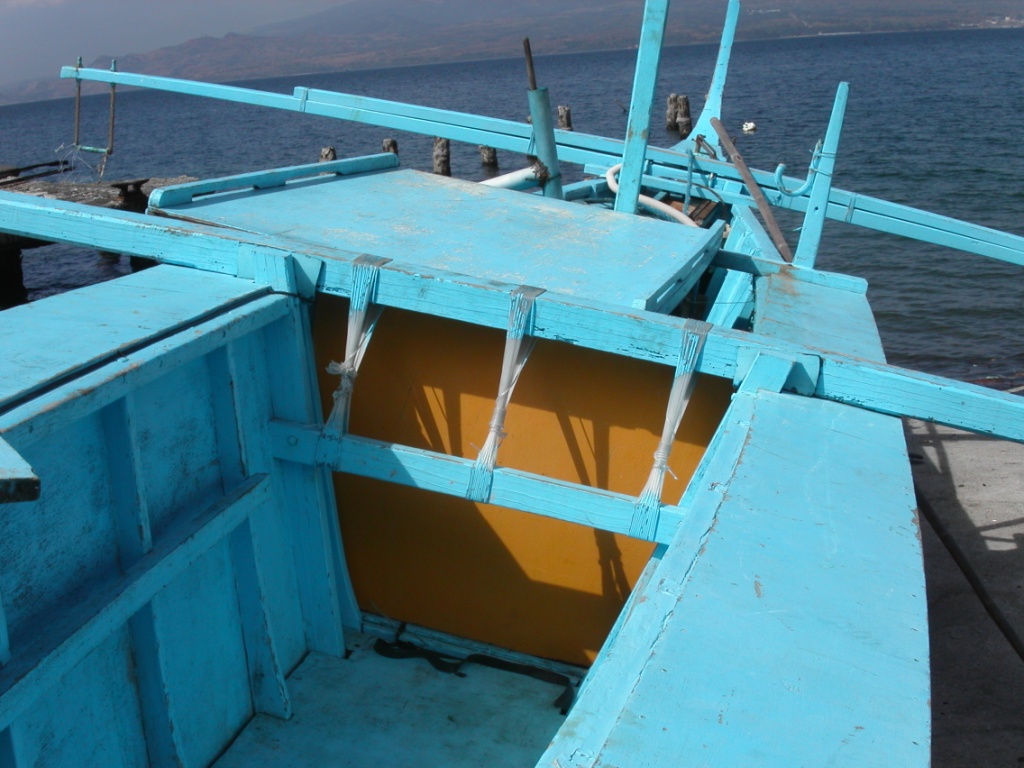
Like most modern bancas, these are inboard powered. The hull appears to be of plywood construction over sawn frames. The text on the stern says "Donated by 125th Coast Guard Auxiliary." (See next image.)
The attachments between outrigger boom and float appear to be pipe hangers. Paul's comment about the garbage being "a bit of a problem" is apparently understatement. 
Yuck. A sorry setting for a handsome boat.
That's more like it! A handsome boat with a nice paint job deserves a clean backdrop.

The banca's narrow hull makes the double outriggers a necessity.
This photo and next: an abundance of heavy-duty monofilament fishing line secures the booms to the hull and the floats to the boom on this banca. The boat in the previous photo had two parallel lengths of bamboo for each float. This one has three. I've also seen floats of one and four lengths: it depends upon the diameter and buoyancy of the bamboo available and the stability needs of the boat.

Tune in again soon for more photos of indigenous Asian boats by Paul Wilson, to whom we give sincere thanks.

Saturday, October 13, 2012

The Moken Kabang

The Moken are an Austronesian people pursuing a nomadic maritime culture in the Andaman Sea. These "Sea Gypsies" live in the Merguyi Archipelago, several hundred islands off the west coasts of Myanmar and Thailand, traditionally spending eight or nine months of each year on the water, and coming ashore only during the monsoon season, during which they would set up temporary communities on islands relatively isolated from the larger mainland societies close by.
Kabang under traditional pandanus squaresail. Source: Moken Projects: http://www.moken-projects.com/site/boat-building/
The kabang is the traditional boat of the Moken, and while propulsion has shifted from a single woven pandanus square sail to outboard engines, the rest of the boat appears to be little changed. It is built on an expanded dugout base, with three strakes per side extending the freeboard to make a hull tall and wide enough to serve as a family home. 
Kabang. Source: http://tausug-global.blogspot.com/2010_12_01_archive.html. Click any image to enlarge.
The dugout base is bifurcated at both ends. Tradition holds that these features represent the living nature of the boat: a mouth at the front and an anus at the rear. The practical purpose, however, is to serve as boarding ladders -- an essential feature because much Moken fishing consists of free-diving for finfish, shellfish, sea cucumbers and the like, and a dramatic form of spearfishing in which the fisherman leaps from the boat's bow with a harpoon in hand.  (Moken are accomplished free divers, commonly remaining submerged for three minutes or more. Moken children's eyes adapt to achieve underwater visual acuity twice that of Europeans.)
Spear-fishing technique from the bow of a kabang. Source: http://kurungabaa.net/2011/08/09/international-day-of-the-worlds-indigenous-peoples-the-mokan/
During construction, the dugout base is expanded (i.e., widened) by inverting the hollowed log and heating it over live fire. The log is then flipped over and, while it is still hot, temporary cleats are slipped over the gunwales near both ends to hold their shapes and prevent splitting. Then V-shaped clamps are slipped over the gunwales closer to midships on both sides and the clamps are levered outboard, pulling the sides with them.  

The wide strakes that are added above the dugout base are traditionally split, not sawn, so that only two planks could be gotten out from a single tree. They are reportedly sewn and pegged in place, but I've found no details on these procedures. Ribs are inserted, and the planks are caulked. (Several photos seem to show the raised sides built not of wide planks but of very narrow strips -- possibly split bamboo?)


Partial decks of narrow planks are laid, and a house whose sides and roof are built of pandanus leaves is added. The sides of the house tilt outward, following the rather shallow angle of the hull sides and no doubt creating a bit more shoulder room inside.


I've not seen any measurements, but I would guess the kabang's length overall at 40' or more. Here's a photo essay showing and further explaining several of the construction steps: unfortunately the images are very small.


An organization called Moken-Projects has partnered with the Kon Tiki Museum to test the sailing characteristics of the kabang in Norwegian waters. Apparently, someone has perceived similarities between the kabang and some ancient Norwegian rock-carvings, and come up with a hypothesis that there's an evolutionary connection between the maritime traditions of Scandinavia and Southeast Asia. Sounds pretty silly to me, but not surprising for a museum founded on the legacy of Thor Heyerdahl. (The perceived similarity is probably that of a bifurcated bow, but several scholars believe the Norwegian carvings represent skin-on-frame boats, not logboat-derivatives, and I believe the rock carvings do not show bifurcated sterns like the kabang's.) (Here's a link to Moken-Projects, but beware: when I visited, some pages were infected by malware.) 


The Moken culture is in fairly dire condition, with perhaps 3,000 or 4,000 members remaining in total, and possibly as few as 1,000 still pursuing a traditional maritime-nomadic lifestyle. A movie called "No Word For Worry" about the Moken people and Moken-Projects is in production.


More news about Moken-Projects is on Facebook.